There was a time when making something look polished was difficult. A perfectly retouched photograph required skill. A sophisticated illustration took hours or days. Creating realistic lighting, believable textures, flawless gradients, dimensional typography, or an elaborate advertising image required a designer, photographer, illustrator, retoucher, or sometimes an entire creative team.
That difficulty gave polished design value.
Today, you can type a few sentences into an AI image generator and receive something beautifully lit, highly detailed, technically impressive, and visually polished in seconds.
And that creates an interesting problem. What happens when perfect-looking design becomes incredibly easy to make?
We may already be seeing the answer. Perfect design is beginning to look cheap.
Not because good craftsmanship has stopped mattering. Not because professional graphic design is disappearing. And certainly not because designers should suddenly start making everything messy.
Something much more important is happening. Artificial intelligence is changing what we perceive as valuable in visual communication. When almost anyone can generate polished imagery, polish alone is no longer enough to make creative work distinctive.
The advantage begins moving somewhere else.
Toward ideas. Toward originality. Toward judgment.
Toward personality. Toward emotion.
Toward the hundreds of subtle creative decisions that make us recognize that there was actually a person behind the work.
This may turn out to be one of the most important graphic design trends of 2026, and perhaps one of the biggest shifts in the future of graphic design.
AI Has Made Visual Perfection Abundant
For most of modern graphic design history, technical execution acted as a barrier. You needed to know how to use professional design software. You needed to understand photography, typography, composition, color, retouching, illustration, printing, layout, or production.
Even after software such as Photoshop and Illustrator dramatically changed the design industry, creating high-quality work still required significant knowledge.
AI design tools are removing another layer of that barrier. Generative AI can now help create:
- illustrations
- photography
- product imagery
- advertising concepts
- social media graphics
- presentation visuals
- textures
- backgrounds
- patterns
- icons
- website layouts
- video
- animation
- copy
- branding concepts
And AI graphic design technology continues to improve extremely quickly. Adobe's 2026 research found that 93% of surveyed creators said creative AI helps them produce content faster. But there is an equally important second part of that finding: 57% said their AI-generated creative work still required moderate or extensive editing before it was ready to publish.
That distinction matters. AI is becoming exceptionally good at producing output. But output is not the same thing as design. The fact that something looks technically impressive does not automatically make it meaningful, strategically appropriate, distinctive, memorable, or effective.
And as AI-generated design becomes more common, audiences are beginning to recognize that difference too.
We Are Entering an Era of Visual Abundance
Think about what happened to photography. Decades ago, photographs were relatively scarce. Film cost money. Developing photographs cost money. Cameras required some technical knowledge. Publishing an image required access to printing or media distribution.
Then digital photography arrived. Then smartphones. Then social media. Suddenly, humanity went from producing a relatively limited number of photographs to producing an almost incomprehensible number of them.
Photography did not become worthless. But simply being able to produce a technically competent photograph became much less remarkable.
Something similar is happening with graphic design and visual content. AI is creating visual abundance. A business owner who previously needed to hire someone to create ten advertising images may soon be able to generate hundreds. A marketer can explore dozens of concepts before lunch. A designer can generate hundreds of visual directions that would previously have taken weeks to produce.
That sounds like an incredible creative advantage, and in many ways it is. But abundance changes value. When something becomes easy to produce, simply having more of it stops being particularly impressive.
The question changes from "Can you make this?" to "Should you make this?" And eventually: "Why should anyone care about this?"
Those are design questions. Not software questions.
The Problem With the AI Look
If you spend enough time online, you have probably already developed a strange new visual instinct. You see an image and immediately think: "That looks like AI." Sometimes you cannot even explain why.
The lighting looks suspiciously dramatic. The composition feels overly cinematic. Everything is beautiful but strangely generic. The people look polished but emotionally vacant. The textures are incredibly detailed but somehow meaningless. Every object seems intentionally positioned, yet nothing feels deliberately designed.
It is a strange contradiction. The image may contain extraordinary technical detail while simultaneously feeling creatively empty.
Audiences appear to be noticing this phenomenon too. Canva's 2026 marketing research found that 70% of consumers surveyed said they could usually recognize AI-generated advertising because it felt like something was missing. The research also found that marketers identified empathy, human imperfection, brand intuition, and creative judgment as qualities AI cannot fully replicate.
That phrase is important: something is missing.
The problem is not necessarily that audiences hate artificial intelligence. It may simply be that they can feel when creative work has no meaningful point of view.
From "Perfect" to "Imperfect by Design"
One of the most interesting design trends of 2026 is a movement away from hyper-polished visual aesthetics.
Canva has described 2026 as the year of "Imperfect by Design," identifying a broader creative movement toward work that feels rawer, more tactile, more personal, and less optimized for algorithmic perfection.
Its research found that 77% of surveyed creators still considered AI an essential creative partner, while 80% said 2026 represented an opportunity to regain creative control.
This is an important distinction. The return of imperfect design is not necessarily an anti-AI movement. It is a response to visual sameness. Designers are not abandoning technology. They are trying to put personality back into what technology produces.
Adobe's 2026 Creative Trends Forecast points toward a similar cultural shift. Despite the increasing influence of AI, augmented reality, and digital technology, Adobe has identified growing interest in organic, analog, realistic, sensory, emotional, locally influenced, and human-centered visual design.
In other words: the more digital our creative world becomes, the more we seem to crave evidence of humanity.
Why Imperfect Graphic Design Suddenly Feels Fresh
Look around contemporary graphic design and branding and you will see more:
- Handwritten typography
- Rough illustration
- Visible grain
- Collage
- Scanned paper
- Halftones
- Imperfect printing effects
- Unusual cropping
- Awkward photography
- Unexpected color combinations
- Mixed typefaces
- Broken grids
- Handmade elements
- Zine-inspired layouts
- Naive drawings
- Physical materials
- Unpolished behind-the-scenes imagery
These things are not new. Designers have used them for decades. What has changed is their context.
When digital tools were limited, a perfectly smooth gradient felt impressive. When everything online becomes perfectly smooth, the rough texture becomes interesting. When photography was difficult, perfect photography communicated professionalism. When AI can create a flawless photograph of almost anything imaginable, an oddly cropped real photograph taken with a phone can communicate authenticity.
Scarcity creates value. And visual imperfection is becoming scarce.
But This Does Not Mean Bad Design Is Good Design
This is where designers need to be careful. There is a dangerous interpretation of the current graphic design trend toward imperfection: "Great. Rules don't matter anymore."
That is not what is happening. Intentional imperfection and accidental incompetence are very different things.
A designer who understands typography can deliberately create tension between two typefaces. A beginner who randomly selects six fonts has not created experimental typography.
A designer who understands grids can intentionally break a grid to create movement. A designer who does not understand alignment simply creates disorder.
A photographer might intentionally use harsh flash because it supports a particular aesthetic. Bad lighting caused by not understanding photography is something else entirely.
A designer might intentionally create rough edges, uneven spacing, or awkward proportions because those decisions create personality. That only works when those decisions are intentional.
The design fundamentals still matter. In fact, they may matter more. Because the better AI becomes at generating competent visual material, the more designers will need to understand why one creative decision works better than another.
AI Can Generate Options. Designers Still Need to Choose.
Imagine an AI tool generates 100 logo concepts. That sounds powerful. But now someone needs to decide:
- Which concept is appropriate for the brand?
- Which one is distinctive?
- Which symbol creates unwanted associations?
- Which one will reproduce at small sizes?
- Which typography matches the company's personality?
- Which logo works in one color?
- Which idea could still feel relevant ten years from now?
- Which option looks too similar to a competitor?
- Which concept communicates the positioning of the company?
- Which one simply looks trendy?
AI generation does not eliminate these decisions. It multiplies them.
This is why one of the most valuable skills in the future of graphic design may not be the ability to generate more ideas. It may be the ability to recognize the right idea.
Taste May Become One of a Designer's Most Valuable Skills
Designers sometimes talk about "taste" as though it were mysterious. But taste is not magic. Creative taste is built through exposure, study, experience, failure, observation, experimentation, and understanding.
You develop taste when you can look at two similar designs and recognize why one feels stronger. You notice that one composition creates a better hierarchy. One headline has better proportions. One photograph communicates more emotion. One color combination creates the appropriate tone. One concept is clever but strategically wrong. One design trend already feels overused. One piece of work simply needs something removed.
AI can generate. But someone still has to evaluate.
Adobe's 2026 Creators' Toolkit research found that 81% of creators surveyed said human judgment remains essential to creative taste.
That may be one of the most important statistics for graphic designers worried about artificial intelligence. Because as AI design tools become easier to operate, simply knowing how to use the tools becomes less valuable. Knowing what to do with them becomes more valuable.
The Designer's Role Is Moving Upstream
For years, designers have spent enormous amounts of time executing: removing backgrounds, resizing layouts, searching for images, retouching photography, creating variations, building mockups, exploring compositions, preparing production files, creating assets.
Much of that work will increasingly be assisted or automated by AI. Understandably, this makes many graphic designers nervous. But there is another way to view the change.
If execution becomes faster, designers can spend more time on:
- creative direction
- conceptual thinking
- visual strategy
- brand positioning
- storytelling
- research
- art direction
- experimentation
- evaluation
- refinement
- audience understanding
- design systems
- decision-making
In other words, designers can spend more time designing.
Adobe has described a similar shift toward the rise of the creative director as generative and agentic AI increasingly handles parts of creative execution. Adobe also warns that if creative automation is used without strong human direction, the result can become uniform, frictionless, overly perfect, and forgettable.
That is the real risk of AI graphic design. Not necessarily that everything becomes ugly. That everything becomes competent. And identical.
"Good Enough" Design Is About to Become Everywhere
AI does not need to create brilliant graphic design to disrupt the design industry. It simply needs to create design that is good enough. That distinction is critical.
There are millions of visual communication tasks where businesses do not require groundbreaking creativity. They need a social post, a promotional banner, a presentation, a basic advertisement, an email graphic, a simple illustration, a flyer.
If AI can create something acceptable in seconds, much of that production work may change dramatically.
But there is an unexpected consequence. If everyone gains access to acceptable design, acceptable design stops becoming a competitive advantage.
Imagine every restaurant has attractive branding. Every startup has a polished website. Every social media account has attractive imagery. Every small company has professional-looking advertisements.
What differentiates them? Not polish.
Ideas. Personality. Positioning. Voice. Storytelling. Brand recognition. Creative direction.
That is why the widespread adoption of AI design tools could actually increase the importance of sophisticated graphic design.
When Everything Looks Professional, Nothing Looks Special
This may be the central creative challenge of the AI era. Technology is democratizing professional-looking visual communication. That is a good thing in many ways. More people can communicate ideas visually. Small businesses gain creative tools they could never previously afford. Designers can prototype ideas faster. Students can experiment more freely. Creative teams can explore directions that would previously have been too expensive.
But democratization also creates sameness. Templates already showed us this.
Think about what happened when certain design platforms, website builders, social templates, and startup branding trends became enormously popular. Suddenly everything began using the same geometric sans serif fonts, the same pastel gradients, the same minimalist illustrations, the same rounded cards, the same startup photography, the same carefully arranged product mockups, the same visual language.
AI can accelerate this phenomenon dramatically. Because generative AI learns from existing visual culture. Without strong creative direction, it tends to move toward recognizable patterns. And recognizable patterns eventually become clichés.
AI Slop and the Value of Restraint
The internet has already developed an unflattering term for enormous quantities of low-value AI-generated content: AI slop.
The term does not simply describe badly generated images. It describes a mentality. Generate more. Publish more. Fill every space. Automate every channel. Create infinite variations. Never stop producing.
But great design has never been about producing the most. Graphic design is often an act of reduction. A designer asks:
- Do we actually need this?
- Does that image communicate anything?
- Can this headline be shorter?
- Does this element compete with the message?
- Would the layout become stronger if we removed half of it?
- Does this brand need another color?
- Do we need ten social posts, or one excellent idea?
AI makes addition extraordinarily easy. The graphic designer's role may increasingly become subtraction.
Real Photography May Become a Luxury
One fascinating consequence of AI-generated imagery may be the increasing perceived value of real photography.
For years, businesses often treated photography as the expensive option. Why hire a photographer when you can use stock? Now the question becomes: why organize a real photoshoot when AI can create the image?
But precisely because businesses can generate fake photographs so easily, authentic photography may become more powerful. A photograph of your real employees, your real restaurant, your real customers, your real products, your real workshop, your actual location, your actual process suddenly contains something AI cannot manufacture in exactly the same way.
Evidence. It tells the audience: this happened.
That may become increasingly important in brand identity design, advertising, social media design, and visual storytelling.
We are already seeing backlash in areas such as restaurant marketing, where AI-generated food imagery has sometimes replaced imperfect but authentic photography, creating visuals that audiences perceive as strange, artificial, or untrustworthy. Recent criticism has even created nostalgia for the awkward, homemade food photography that small businesses once tried to eliminate.
The technically inferior photograph may sometimes become the stronger communication tool because it is believable.
Texture Is Becoming Evidence
Another major graphic design trend in 2026 is texture: paper grain, ink, paint, fabric, scratches, scans, halftones, photocopier artifacts, rough edges, printed materials, visible physical processes.
Why are designers suddenly so interested in making digital design feel physical? Partly because screens have become almost too perfect. Modern software can produce immaculate vectors, smooth gradients, infinitely scalable typography, and pixel-perfect layouts. AI pushes that even further.
So designers introduce friction. Texture becomes evidence that something has been touched, made, altered, printed, photographed, scanned, painted, or handled.
Canva's 2026 trend research includes tactile visual styles among the major movements toward more human and imperfect creative work, while Adobe's 2026 trend forecast similarly emphasizes sensory experiences and visuals that feel tangible rather than purely digital.
Texture is no longer simply decoration. It can communicate humanity.
Branding Will Need More Personality
For branding, the implications are enormous. Many businesses spent the last decade simplifying. Logos became cleaner. Typography became safer. Color palettes became softer. Websites became standardized. Digital-first brand systems prioritized usability, consistency, and scalability.
Those were often sensible decisions. But optimization has a side effect: similarity. When every company follows the same rules, brands begin blending together.
The next generation of successful brand identity design may need to balance usability with much stronger personality. That could mean distinctive typography, recognizable art direction, unusual illustration, ownable photography, brand-specific motion, custom lettering, unexpected compositions, physical materials, stronger verbal personality, visual devices unique to the brand.
The goal is not to make branding chaotic. The goal is to make it recognizable. There is a massive difference.
Distinctiveness Will Matter More Than Beauty
Designers love beautiful things. But beautiful is not always the goal. Branding needs to be recognizable. Advertising needs to communicate. Editorial design needs to guide attention. Packaging needs to differentiate. User interfaces need to help people complete tasks. Graphic design solves communication problems.
AI can generate endless beautiful imagery. That means beauty itself becomes less scarce. Distinctiveness becomes more important.
Imagine two brands. Brand A has flawless AI-generated photography, tasteful typography, elegant gradients, and perfectly balanced layouts. Brand B has a strange illustrated character, an unexpected typeface, unusual photography, a slightly awkward visual system, and a very specific sense of humor.
Brand A may technically look more polished. But which brand will you remember tomorrow? Probably Brand B. Memorability often lives in deviation.
The Future of Graphic Design Is Not Anti-Technology
None of this means graphic designers should refuse to use AI. That would misunderstand the larger change. AI will almost certainly become part of professional graphic design workflows.
Designers already use artificial intelligence for image cleanup, background removal, image extension, concept exploration, mockups, research, copy exploration, asset variations, brainstorming, automation, image generation, video, and prototyping.
Adobe's research into creative employment provides an interesting counterpoint to predictions that AI would simply eliminate creative careers. Between September 2025 and April 2026, its analysis found U.S. creative professional job postings rising from roughly 10,500 to 11,300, while the percentage explicitly requesting AI skills increased from 10% to 15%.
The signal is not necessarily "designers are disappearing." It may be: "what companies expect designers to know is changing."
Designers need to become good at using AI without looking like AI. The best AI-assisted graphic design probably will not look like AI-assisted graphic design. The technology should disappear into the process. A photographer does not want viewers thinking "wow, they really know how to use Photoshop." A designer does not want someone looking at a poster and thinking "excellent use of Illustrator." The software is not the point. The idea is the point. The same should eventually become true of AI. The goal should not be "look what AI generated." The goal should be "look at this idea."
What Designers Should Learn in the Age of AI
If you are learning graphic design right now, it is understandable to wonder what skills are still worth learning. Should you study Photoshop if AI can edit images? Should you study Illustrator if AI can create vectors? Should you study layout if AI can generate websites? Should you learn typography if software can recommend fonts?
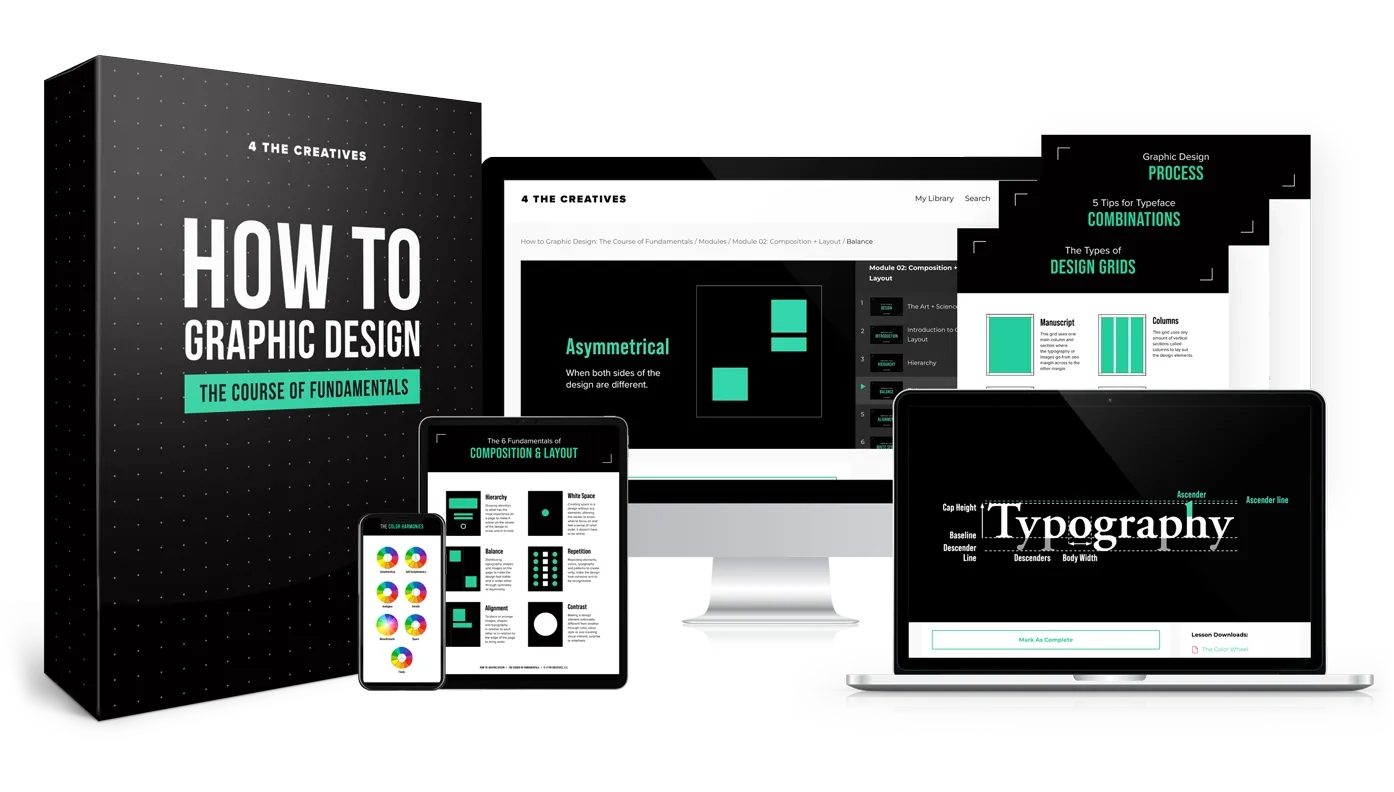
Yes. But perhaps for a slightly different reason. You are not only learning how to execute. You are learning how to judge. If you're just getting your footing, see our guide on how to learn graphic design for a structured place to start — everything below builds on those same fundamentals.
Here are the skills that may become increasingly valuable as AI graphic design develops.
Typography
AI can recommend typefaces. It cannot eliminate the need to understand hierarchy, spacing, readability, proportions, tone, contrast, and typographic relationships. Typography remains one of the strongest indicators of professional graphic design.
Composition
Knowing where to place elements and, just as importantly, what not to include is fundamental to visual communication. AI can generate compositions. Designers need to evaluate them.
Visual Hierarchy
A design may contain everything the client requested and still fail because the viewer does not know where to look. Understanding hierarchy will remain essential.
Concept Development
The first idea is rarely the best idea. Graphic designers need to develop concepts that communicate something rather than simply decorate something.
Brand Strategy
AI can make a logo. Understanding what a company should represent is a different problem.
Creative Direction
As execution becomes easier, the ability to establish a strong visual direction becomes increasingly valuable.
Art Direction
Photography, illustration, typography, styling, composition, motion, and visual language need to work together. Someone has to orchestrate them.
Audience Understanding
Graphic design is communication. Knowing who you are communicating with remains fundamental.
Editing
Knowing what to remove may become one of the most important design skills of the AI era.
Taste
You need to recognize when something is technically impressive but creatively weak. That ability cannot be replaced by simply generating another 100 versions.
There is an uncomfortable side to this conversation. Some graphic design work will likely be automated. Ignoring that possibility is not useful.
If your primary professional value is "tell me exactly what to make and I will operate the software to make it," AI creates a genuine challenge. But professional design has always been more valuable when the designer participates in solving the problem.
A stronger designer asks: why are we making this? Who needs to see it? What should they understand? What should they feel? What is the strongest idea? What should the hierarchy be? What does this communicate about the brand? What is unnecessary? How can this become more memorable?
Those questions exist above the software level. And that is where graphic designers should increasingly position themselves.
Design Fundamentals May Become More Important, Not Less
This is perhaps the biggest irony of the AI revolution. AI appears to make design fundamentals unnecessary. But AI may actually make them more valuable.
Why? Because designers are going to have more options than ever before. Previously, generating 50 visual directions might have been impossible because it would take too much time. Now it might take minutes. But someone still has to evaluate those 50 options. That evaluation requires knowledge.
Without understanding graphic design principles, more options do not necessarily help. They create confusion. When AI generates hundreds of possibilities, fundamentals provide the filter.
Contrast. Alignment. Hierarchy. Scale. Color. Typography. Balance. Composition. Repetition. Rhythm. Proportion.
These are not outdated rules from an era before artificial intelligence. They are tools for making decisions.
Imperfection Only Works When You Understand Perfection
There is something wonderfully paradoxical about the current trend toward imperfect graphic design. To break rules effectively, you generally need to understand them first.
The great experimental typographer knows conventional typography. The designer creating chaotic editorial layouts understands hierarchy. The illustrator making intentionally naive drawings knows how to control shape and composition. The photographer creating seemingly casual images understands framing and light.
That is what makes intentional imperfection powerful. You can feel the control underneath it. It appears effortless precisely because someone made deliberate decisions.
The New Luxury May Be Evidence of Human Thought
For decades, luxury communication often meant perfection: perfect photography, perfect packaging, perfect surfaces, perfect typography, perfect environments.
But what happens when machines can manufacture perfection instantly? Perhaps the luxury becomes knowing that someone cared.
Someone drew this. Someone photographed this. Someone wrote this. Someone obsessed over that typeface. Someone printed it. Someone cut it. Someone arranged it. Someone rejected fifteen other ideas. Someone chose this particular photograph for a reason. Someone decided that element should not be there.
Canva recently described this broader shift as moving from polish to presence, arguing that when perfection becomes easy to produce, the creative work that stands out increasingly contains evidence of thought and intention.
That may be exactly where graphic design is heading.
Do Not Fake Imperfection Either
Of course, trends eventually become formulas. Once brands realize audiences respond to human-looking design, we will inevitably see corporations manufacturing "authenticity": perfectly generated fake film grain, AI-created handwriting, artificially damaged typography, fake photocopy textures, simulated printing mistakes, manufactured spontaneity, fake behind-the-scenes photographs.
The aesthetic of imperfection can become just as generic as the aesthetic of perfection. That misses the point.
Human-centered design is not about placing a paper texture over everything. It is about thought. The question is not "how can I make this look handmade?" The better question is "how can I make this feel specific?"
Specific to this brand. Specific to this audience. Specific to this idea. Specific to this moment. Specificity is difficult to automate because specificity requires context.
The Best Designers Will Use AI and Still Have a Point of View
The future of graphic design probably will not divide neatly into two camps: AI designers and traditional designers.
The strongest designers will likely use whatever tools help them communicate ideas. Sometimes that might mean AI. Sometimes photography. Sometimes illustration. Sometimes typography. Sometimes pencil and paper. Sometimes an iPhone camera. Sometimes Photoshop. Sometimes a photocopier. Sometimes a piece of cardboard and some paint.
The medium is secondary. The question is always: what serves the idea? That has always been graphic design.
So, Is Perfect Design Really Starting to Look Cheap?
Sometimes. And that may become increasingly common.
Not because professional design is losing value. Quite the opposite. Technical perfection is becoming easier to produce. Therefore technical perfection alone communicates less expertise than it once did.
The value is migrating upward.
Toward creative judgment. Toward strategy. Toward originality.
Toward restraint. Toward storytelling. Toward distinctiveness.
Toward taste. Toward understanding people.
AI may make beautiful visual content abundant. But abundance does not automatically produce meaning. And meaning is what design has always been about.
What This Means for the Future of Graphic Design
The next era of graphic design may be less about proving that you can make something look professional. Machines will increasingly be able to help with that. The challenge will be proving that your work has something to say.
The designers who thrive will not necessarily be the people who can operate the most software or generate the most images. They will be the people who can look at endless possibilities and say: not that one, this one — and explain why.
They will understand typography. Composition. Hierarchy. Brand strategy. Concepts. Culture. Emotion. Communication.
They will know when to use AI. They will know when not to use it. They will know when perfection helps. And they will know when one strange, imperfect, completely intentional decision is the thing that makes a design unforgettable.
AI can generate more. Designers still have to decide what matters. And in the age of artificial intelligence, that may make being a great graphic designer more valuable than ever.